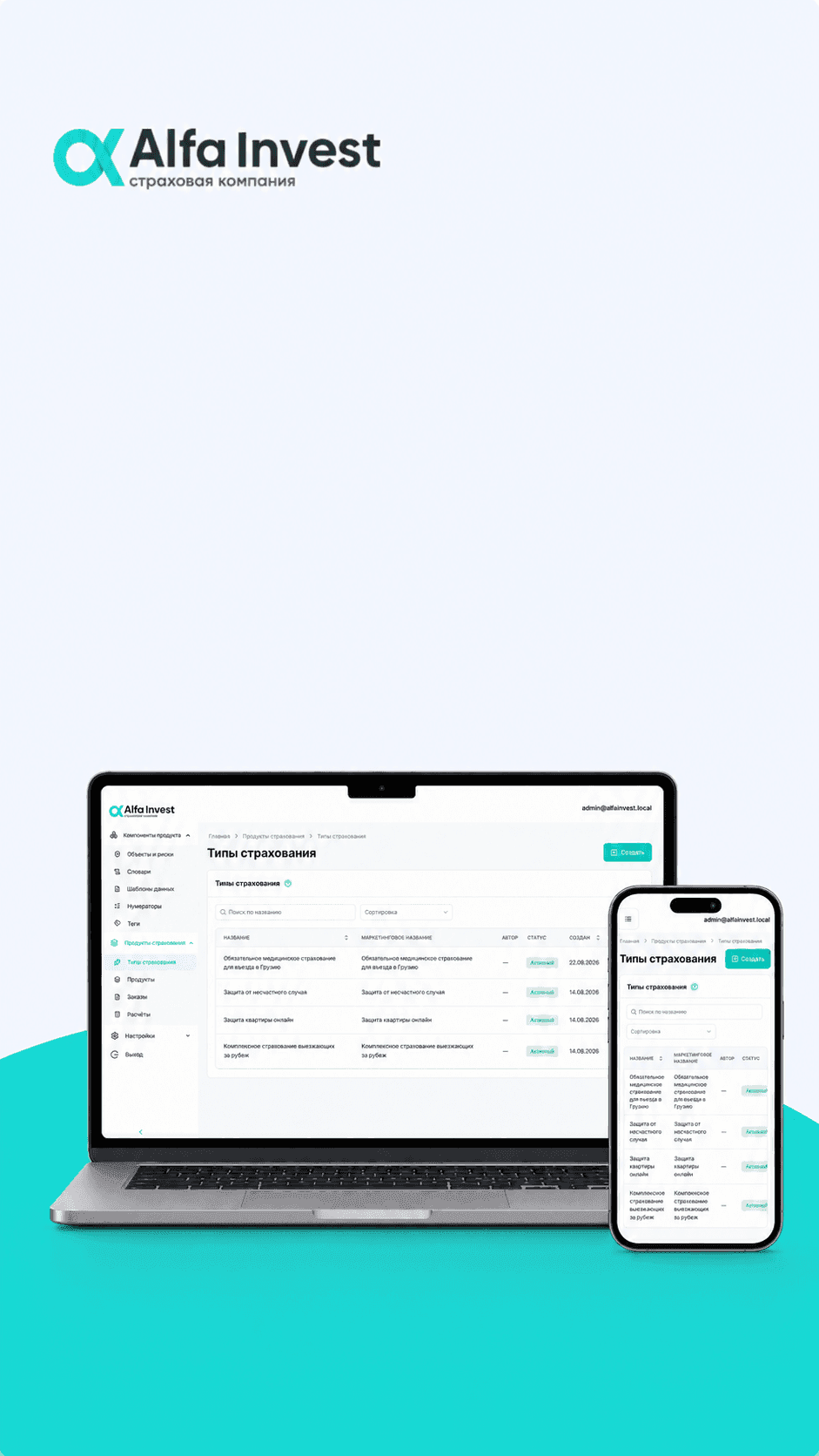
Client
Alfa Invest insurance company.
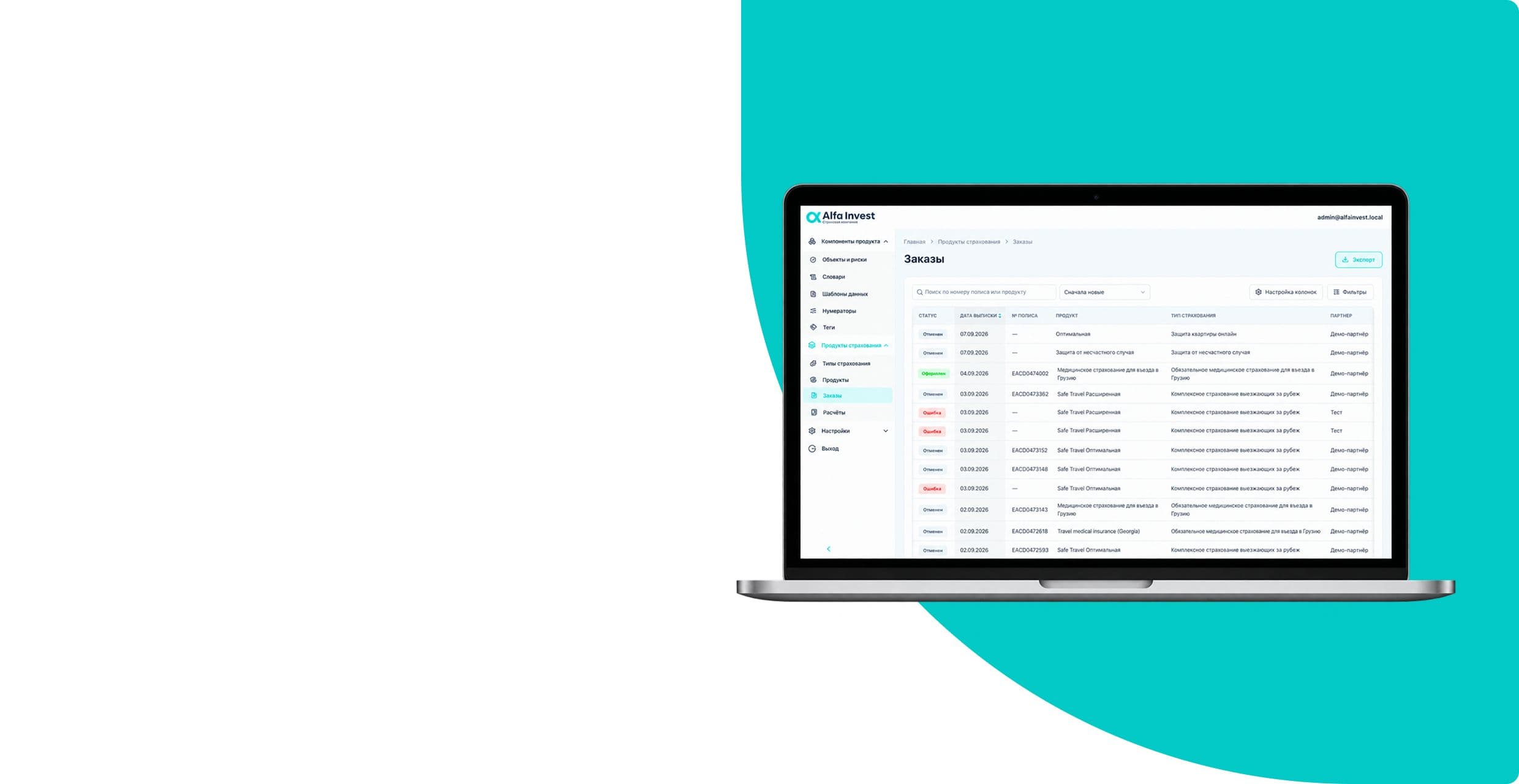
Developed a no-code platform for launching insurance products
Alfa Invest received not a standalone CRM or a set of disconnected portals, but a unified platform where product logic, order processing, partner network management, and settlements operate on shared data.
Alfa Invest insurance company.
Eliminate the dependency of insurance products on external services.
Built a no-code product builder, administrative and partner environments, order management, payment scenarios, policies, commissions, limits, roles, and reporting.
Product teams, administrators, finance specialists, partners, sub-partners, agents, and customers.
Insurance products differ in forms, insured objects, rating factors, calculation rules, documents, and sales channels. With a traditional approach, even a minor change may require analysis, development, testing, and a new release.
Move configurable product logic out of the application code and into manageable settings while preserving version control, permissions, and control over financial operations.
Tell us about the project — we will break down the task and propose an implementation approach.
DevSymfony designed the system as a long-term platform capable of supporting multiple insurance products and the expansion of the partner network.
Insurance types, products, forms, rating factors, documents, and publishing.
Partners, sub-partners, users, products, and data isolation.
Online payments, limits, outstanding balances, commissions, and accrual statuses.
Calculation, application processing, statuses, payment, policy issuance, and document history.
Payment services, documents, external channels, APIs, and reporting.
User portals operate on top of a unified product and operational core. External systems are connected through the integration layer, while access control and audit mechanisms extend across the entire platform.
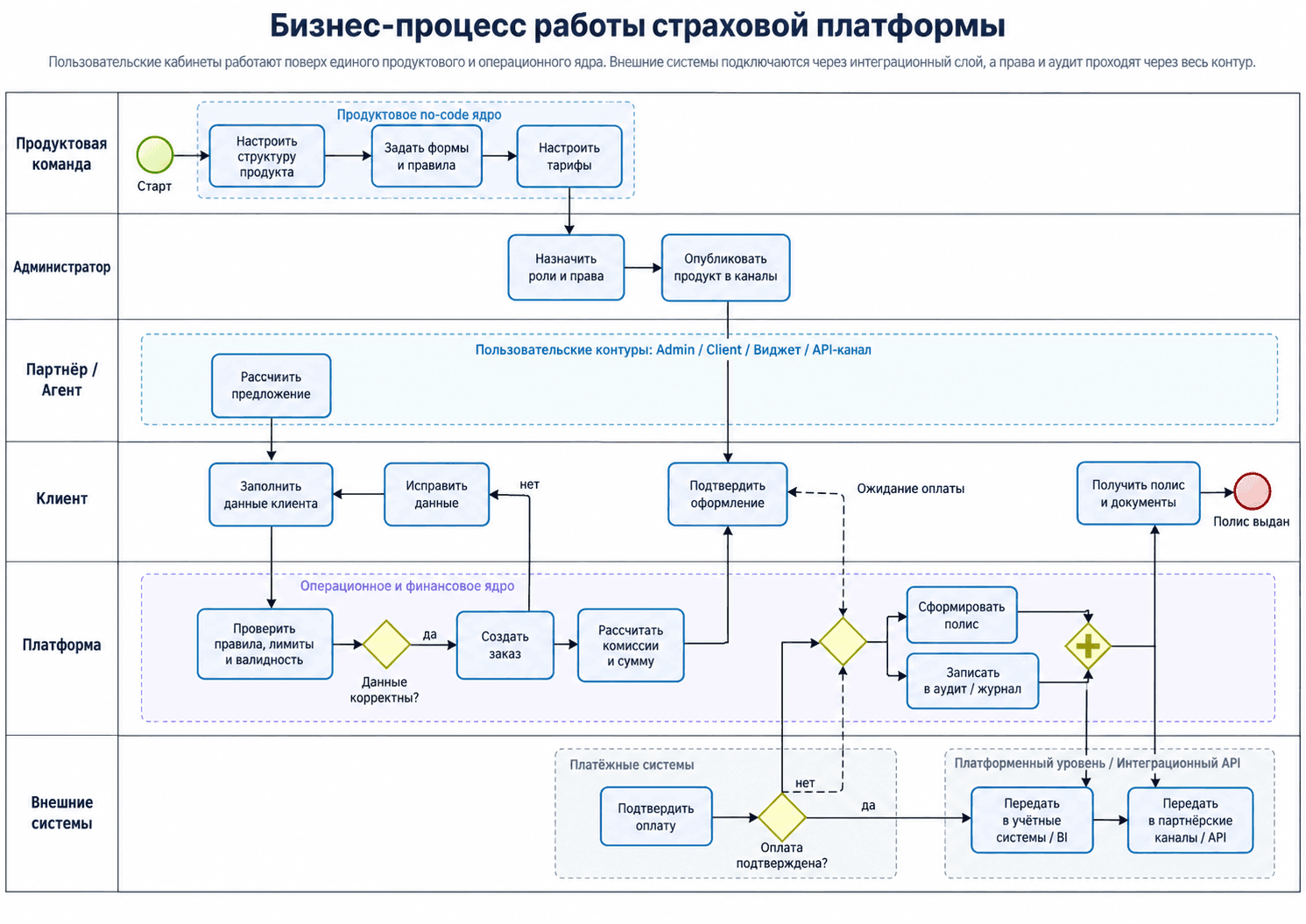
We will show how to connect interfaces, business logic, data and external systems.
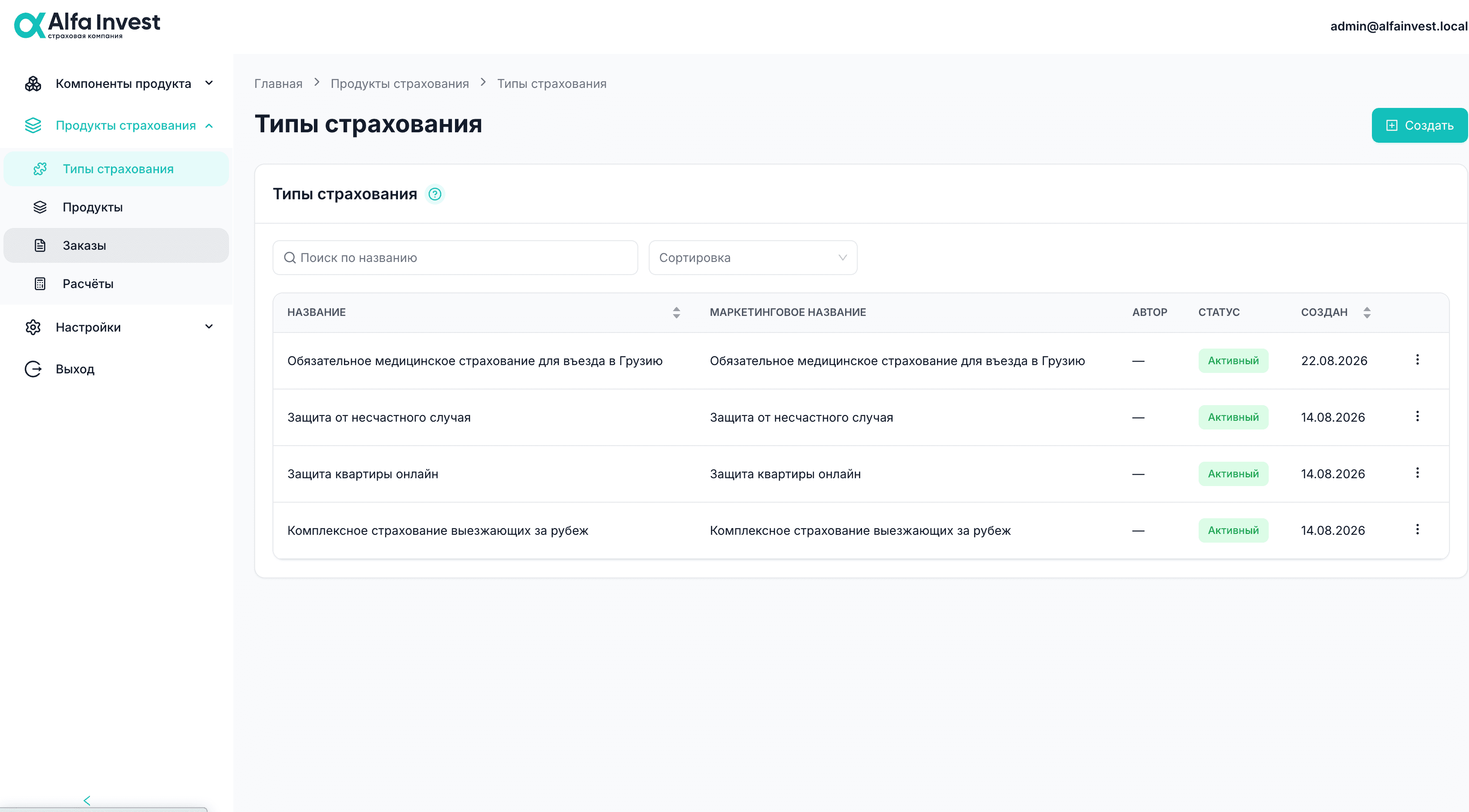
The administrator configures the basic structure of the insurance type, its status, and the parameters used in calculations: region, object type, insured amount, and required-field rules.
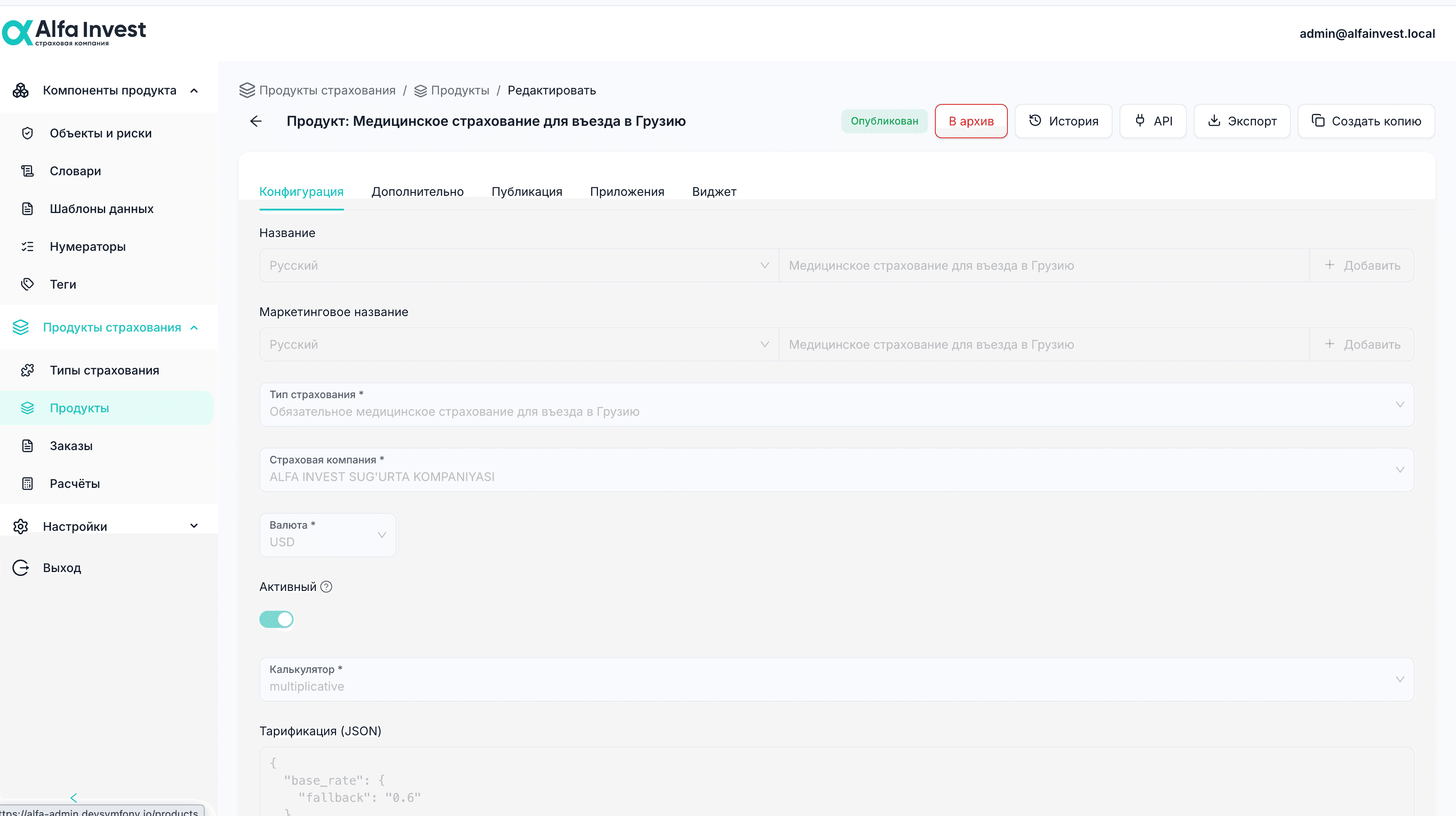
A single screen brings together basic product data, insurance type, company, currency, insured objects, coverage, and navigation to calculation, orders, documents, agreements, and publishing.
Displays all submitted applications and issued policies, including status, date, policy number, product, insurance type, and partner. Search, filtering, sorting, and export are available.
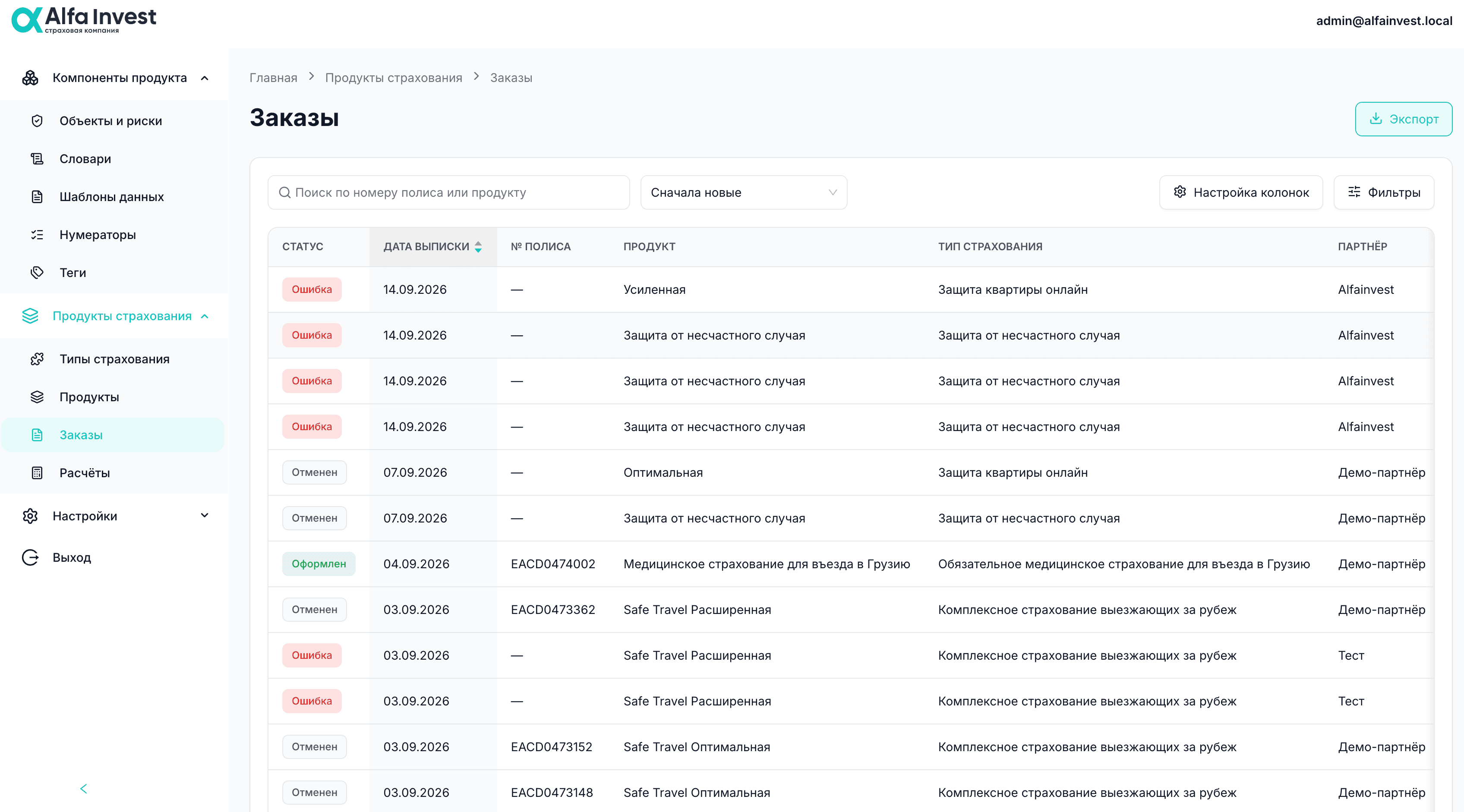
The administrator configures the basic structure of the insurance type, its status, and the parameters used in calculations: region, object type, insured amount, and required-field rules
Defining goals, studying the audience, forming requirements and setting tasks. This helps to understand what the business needs and what results are expected.
Creating the solution architecture, thinking through user scenarios, interfaces and logic. At this stage the 'framework' of the future product is formed.
Programming the server and client parts, connecting databases, integrating with external services. This is where the idea turns into a working product.
Checking functionality, performance, compatibility and security. Fixing bugs before the product reaches users.
Deploying the product (for example, publishing in stores or launching on servers), configuring the environment and starting marketing or internal processes.
Updating functionality, adapting to new business tasks, fixing bugs and keeping the product up-to-date.
After implementation, the company gained its own insurance platform and no longer depended on external insurance services or their integrations.
The company eliminated its dependency on external insurance services and gained its own platform
Insurance products, rates, and parameters can now be configured directly within the company’s own system.
Access rights, limits, commissions, and available products are managed individually for each partner
All participants, roles, and processes operate under unified rules within a single platform.
 01
01 02
02 03
03 04
04 05
05 06
06 07
07 08
08 09
09 10
10 11
11 12
12 13
13 14
14 15
15 16
16 17
17 18
18 19
19We build enterprise solutions using a powerful, proven, and
versatile tech stack designed for performance, scalability, and
security. Our expertise spans
















We will propose a suitable structure and prepare the first sketch of your future project — with no obligation to start development.
You get a visual concept you can discuss with your team.

He will review your project and business objective, prepare recommendations and the first sketch.
An honest conclusion.If the solution can be improved without a full rebuild, we will tell you so.