
Сlient
Amihub digital product; the client’s name is not disclosed in public materials.

An independent analytics platform replacing fragmented services and spreadsheets
Amihub is an end-to-end marketing analytics system. The platform collects data from advertising channels, the website, telephony, and CRM, connects it into a single chain, and calculates performance metrics by source, campaign, and other dimensions.
Amihub digital product; the client’s name is not disclosed in public materials.
Build an end-to-end analytics platform from scratch with its own data processing core.
Developed the product logic, interfaces, backend, data model, integrations, attribution, and reporting.
A proprietary system connecting spend, inquiries, deals, and revenue within a single operational environment.
Before end-to-end analytics is implemented, teams often work with several versions of reality: ad spend is stored in advertising platforms, visits in web analytics, calls in telephony, and deals and revenue in CRM.
Web analytics shows where the visitor came from. CRM shows how the inquiry ended. Advertising platforms show spend. Amihub connects these parts and answers the business question: which source generated not just a lead, but actual paid revenue.
Tell us about the project — we will break down the task and propose an implementation approach.
Defined entities, dimensions, formulas, statuses, and rules that make data comparable.
Designed connections to advertising platforms, the website, calls, and sales systems through APIs, webhooks, and a tracking script.
Connected the anonymous visit, inquiry, CRM lead, deal, and payment into a sequential chain.
Implemented rules for distributing sales value across marketing touchpoints.
Created end-to-end reports, dashboards, funnels, filters, segments, and drill-down views.
An Independent Analytics Core Operates Between Data Sources and Reports
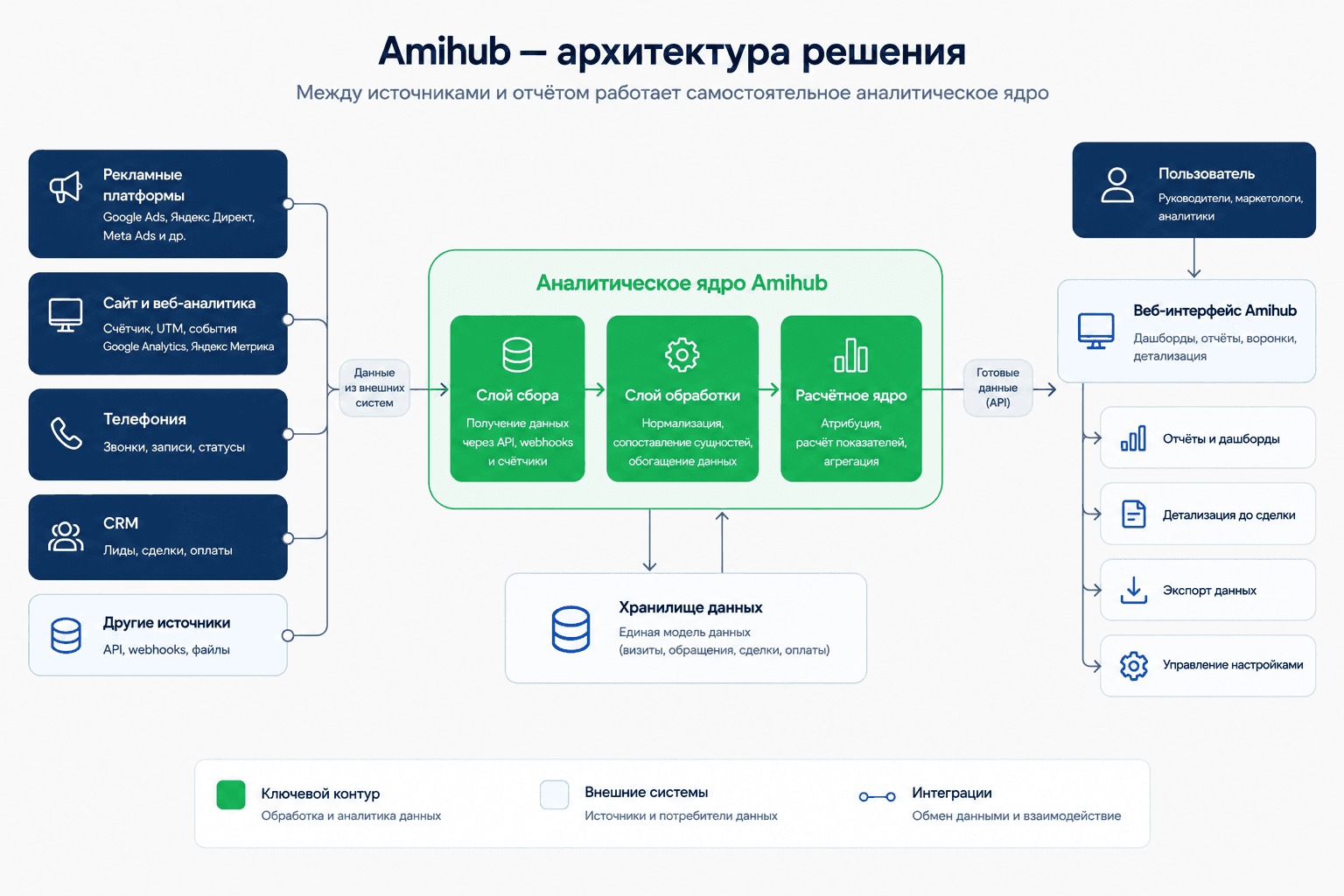
We will show how to connect interfaces, business logic, data and external systems.
The entire marketing data journey in one system.
Loading spend data by channel, campaign, and ad for the selected period.
Tracking script, UTM tags, client ID, goals, and website events.
Compare results using selected value-distribution rules.
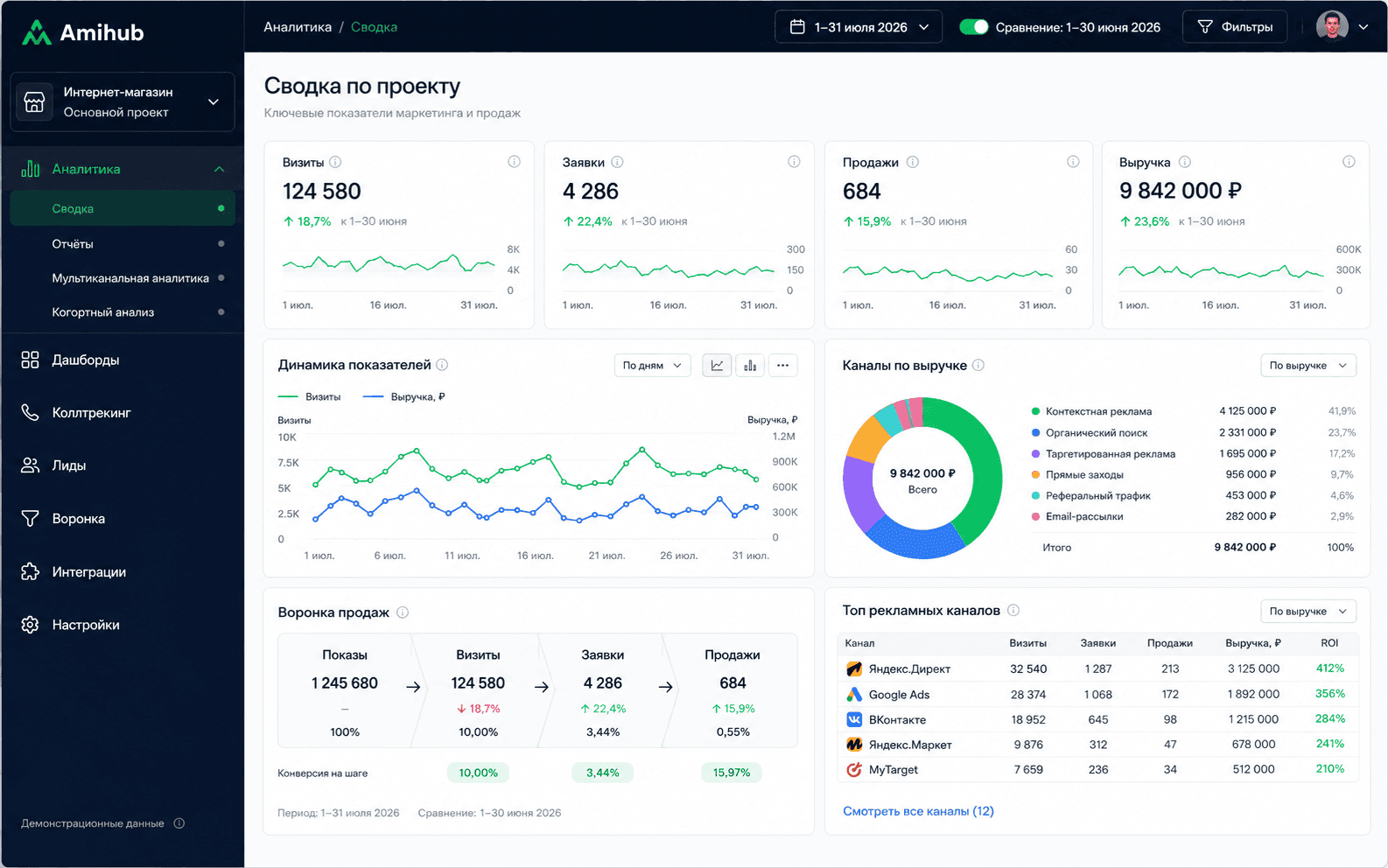
Key metrics, trends, revenue structure, and plan tracking in one overview.
Conversion between visits, inquiries, qualification, sales, and payments.
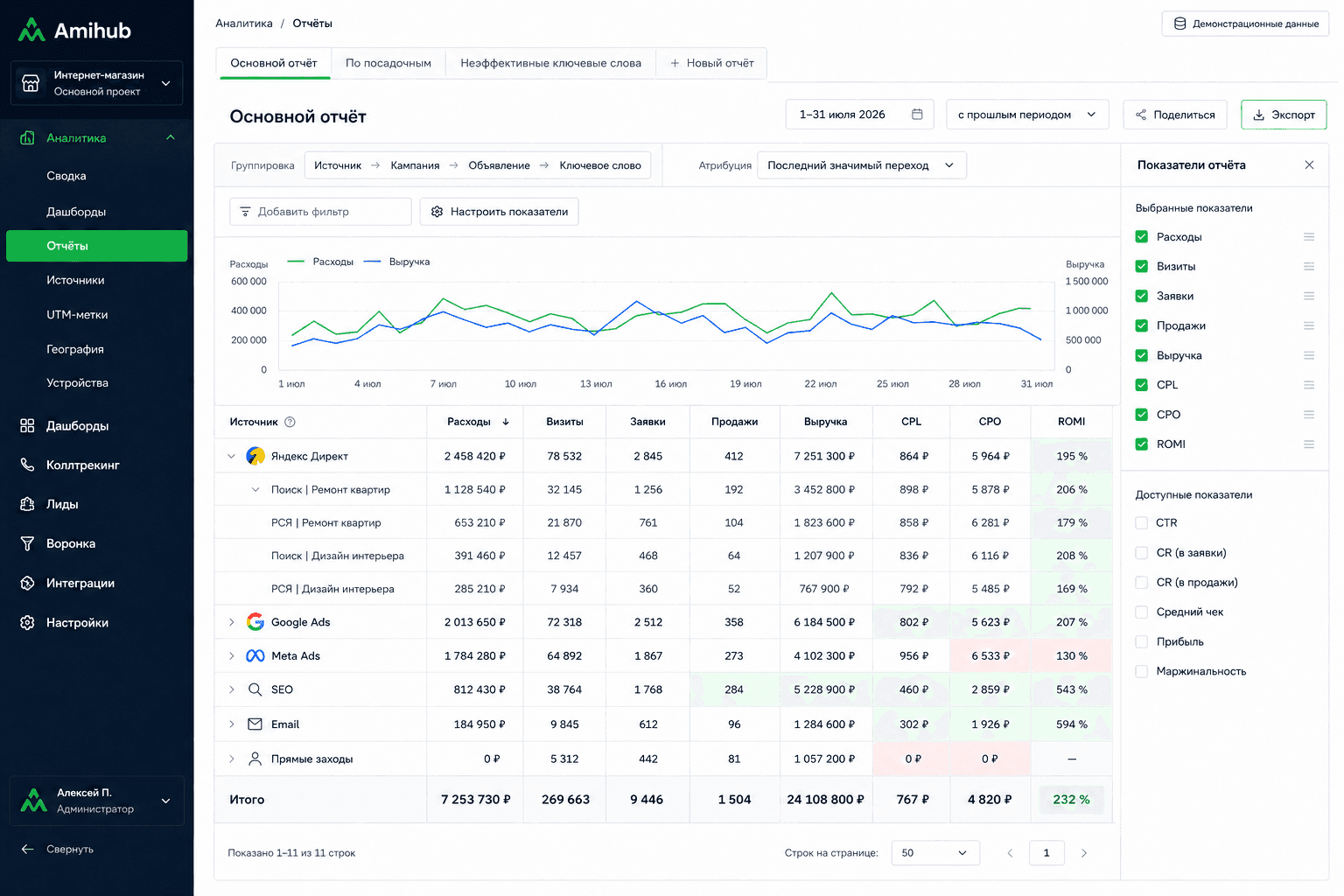
Move from an aggregated channel view to campaign, ad, and individual deal level.
The overview combines spend, inquiries, sales, and revenue, showing trends and channel contribution. It answers the first management question: what happened with marketing during the period and where deeper analysis is required.
Key metrics show the main values and changes compared with the previous period.
The user selects a period, attribution model, and grouping. Rows drill down from source to campaign and ad, while columns combine advertising, website, and CRM data.
Defining goals, studying the audience, forming requirements and setting tasks. This helps to understand what the business needs and what results are expected.
Creating the solution architecture, thinking through user scenarios, interfaces and logic. At this stage the 'framework' of the future product is formed.
Programming the server and client parts, connecting databases, integrating with external services. This is where the idea turns into a working product.
Checking functionality, performance, compatibility and security. Fixing bugs before the product reaches users.
Deploying the product (for example, publishing in stores or launching on servers), configuring the environment and starting marketing or internal processes.
Updating functionality, adapting to new business tasks, fixing bugs and keeping the product up-to-date.
The core end-to-end analytics logic was implemented as an independent product built from scratch.
Source performance is evaluated by sales and revenue, not only by clicks and leads.
Key dimensions and calculations are available directly in the interface without manually consolidating exports.
The architecture allows new data sources, reports, and calculation models to be added.
 01
01 02
02 03
03 04
04 05
05 06
06 07
07 08
08 09
09 10
10 11
11 12
12 13
13 14
14 15
15 16
16 17
17 18
18 19
19We build enterprise solutions using a powerful, proven, and
versatile tech stack designed for performance, scalability, and
security. Our expertise spans



















We will propose a suitable structure and prepare the first sketch of your future project — with no obligation to start development.
You get a visual concept you can discuss with your team.

He will review your project and business objective, prepare recommendations and the first sketch.
An honest conclusion.If the solution can be improved without a full rebuild, we will tell you so.