Client and business
Payment infrastructure with a network of ATMs and offline points in Tashkent. The quality of service depends on how quickly the team receives accurate reports of problems.
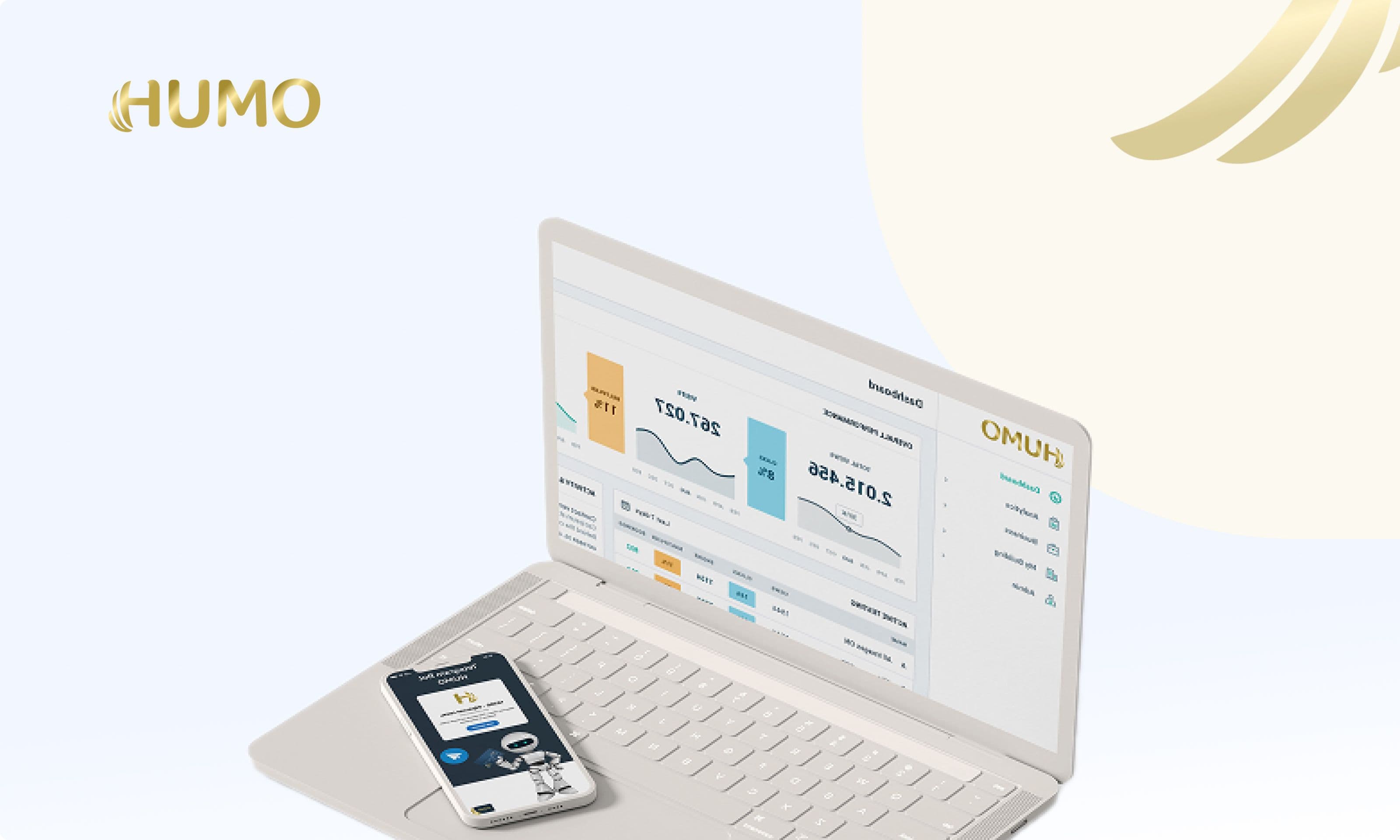
CRM for national processing with analytics, AI and integration with Telegram.
HUMO Pay is a Telegram service for communication with users. One of the key scenarios made it possible to report a non-working ATM: transmit geolocation, attach media, describe the problem and leave a contact. The data arrived on the server and became available to employees in the admin system.
Payment infrastructure with a network of ATMs and offline points in Tashkent. The quality of service depends on how quickly the team receives accurate reports of problems.
Implemented a Telegram bot, server application, administrative panel, roles, geolocation, media loading, moderation, analytics, export, competitions and messages.
Create an accessible channel where the user reports a faulty ATM or contacts support, and employees receive structured data for further work
Cases, contact, location and media are collected in one outline. The team does not need to reconstruct the context of the problem from scattered correspondence.
When a user encounters a faulty ATM, he usually does not know the number devices and internal channel of the responsible department. Comes to support message without precise point, media and contact. Employees have to ask clarifying questions, and some of the context is lost.
Tell us about the project — we will break down the task and propose an implementation approach.
The project was divided into a client Telegram bot, server logic and closed administrative system. For each scenario, it was necessary to determine which data collected, who accesses them and how the information is used next.
We analyzed three user scenarios: a competition, message about the ATM and contact technical support.
Added moderation, users, requests, competitions, analytics and export. Implemented server functions, sessions, queue load, storage and access rights
Designed dialogues for Telegram bot and web administrative system interface
Linked the Telegram API, integration adapters, application services, database and panel
Prepared the server circuit and secure employee access to the closed part
The user interacts with the bot via Telegram. The client part collects the selected script, contact, geolocation, message and media. The integration layer transfers data application services, and the server stores them in the database and applies access rules.
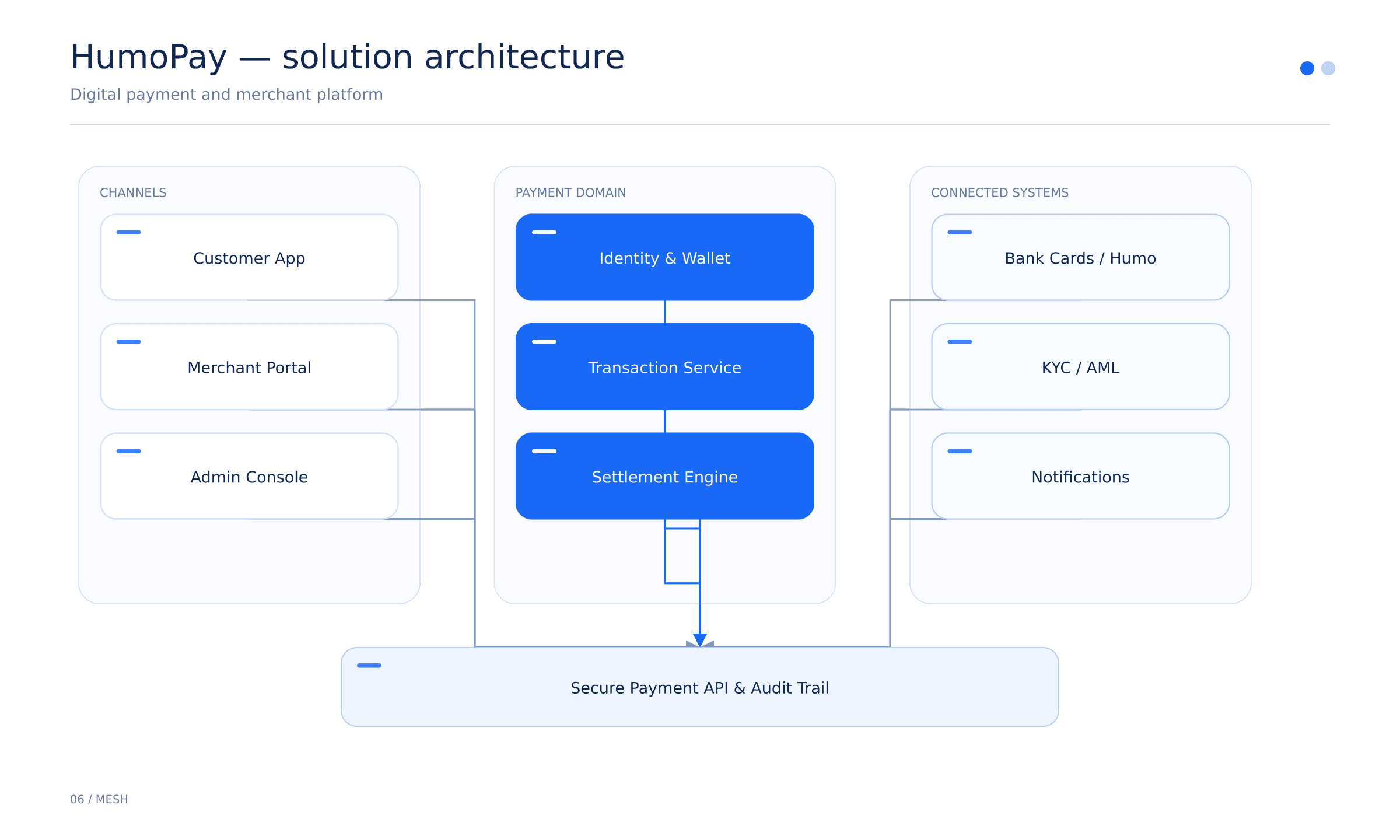
We will show how to connect interfaces, business logic, data and external systems.
The system connects a fast user channel with controlled internal work employees.
The user transmits geolocation, media, description and contact. Benefit: support receives context in one package.
The bot accepts the question and contact information. Benefit: the message is not lost in personal correspondence.
The participant sends data through the bot, and employees moderate the application. Benefit: activity controlled from the same panel.
The user selects Russian or Uzbek language. Benefit: one service is available to a wide audience.
Super-administrator and moderator receive different powers. Benefit: sensitive functions protected.
Data from users, competitions and requests available for analysis and Excel download. Benefit: flow can be taken into account and passed on
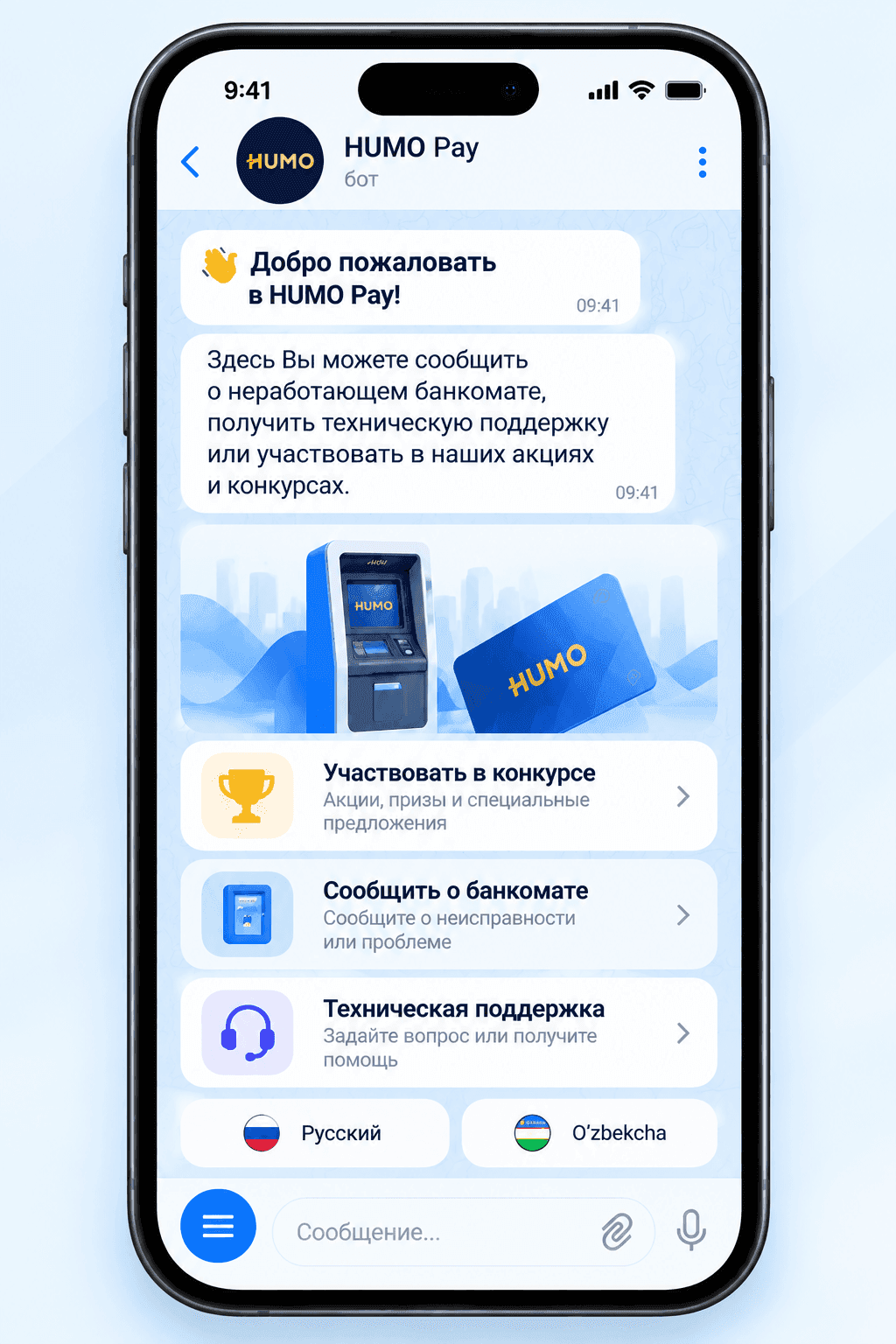
The user selects one of three scenarios: participation in a competition, reporting a non-working ATM or contacting technical support. Language switches between Russian and Uzbek.
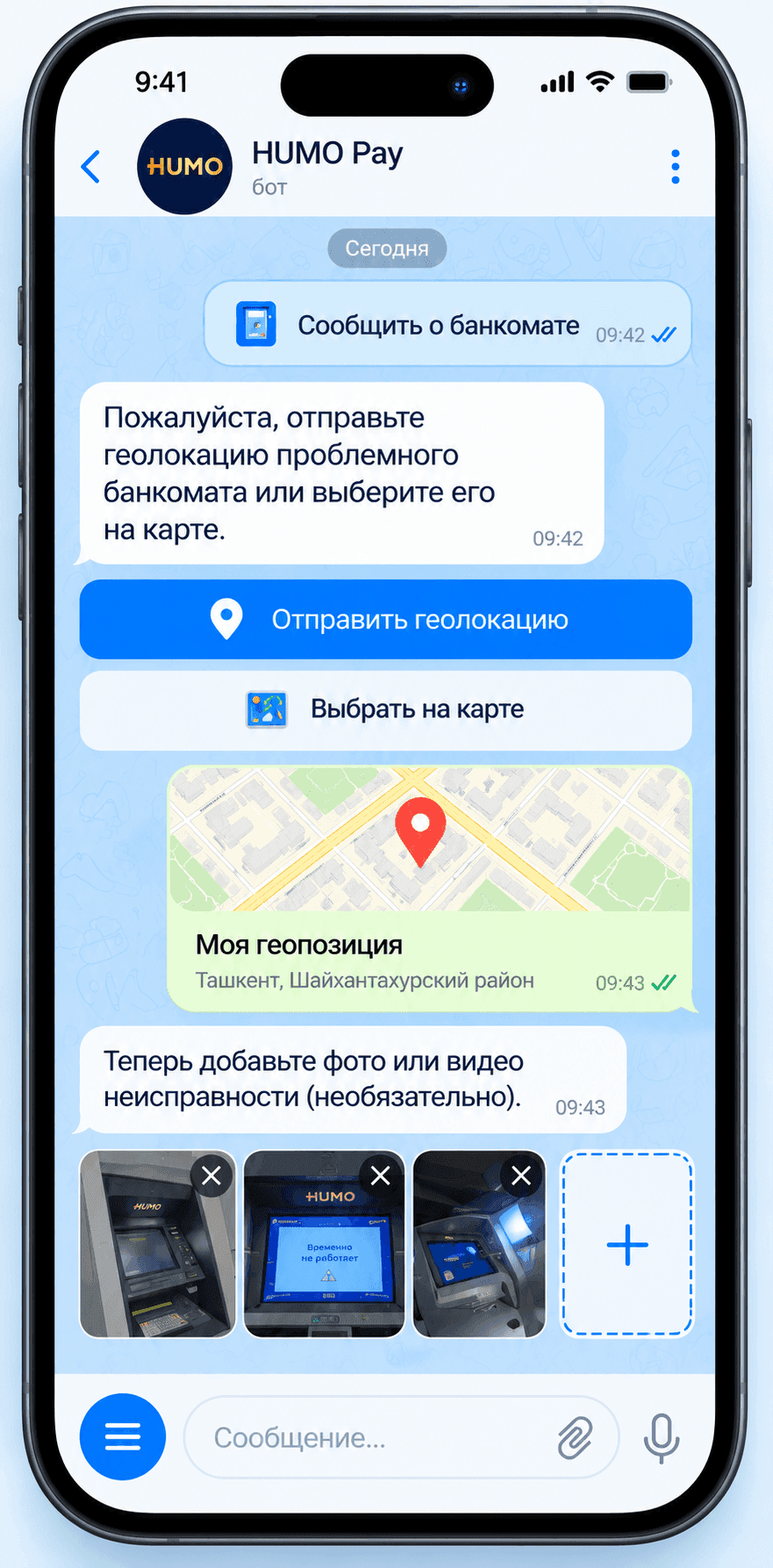
The bot consistently requests geolocation, photo or video, description of the problem and contact. This procedure reduces the number of incomplete requests.
Home screen brings together ATM inquiries, support requests, and activity competition. Indicators are displayed for the selected period without reference to fictitious values
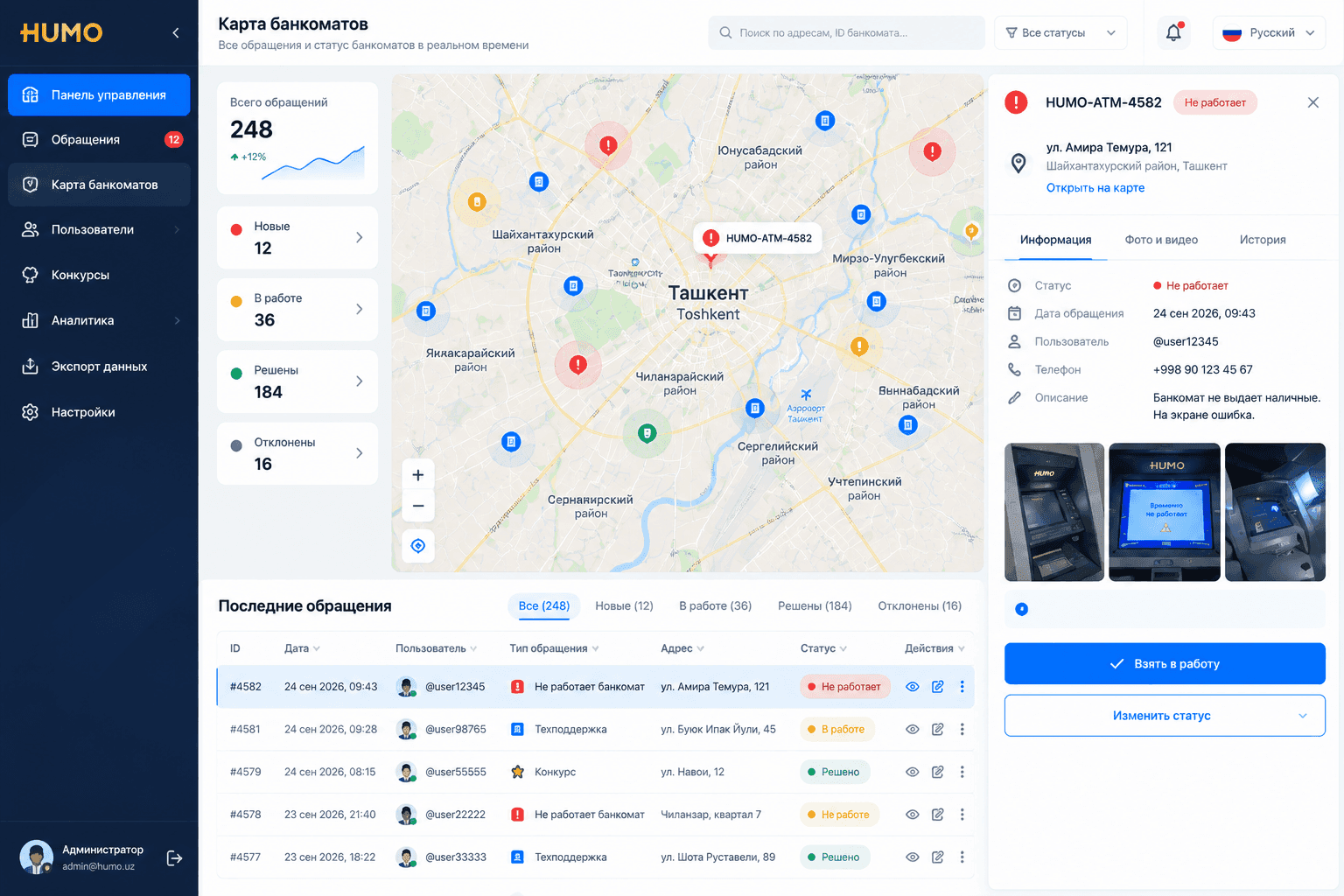
We will analyse the functionality and build a clear interface structure.
Defining goals, studying the audience, forming requirements and setting tasks. This helps to understand what the business needs and what results are expected.
Creating the solution architecture, thinking through user scenarios, interfaces and logic. At this stage the 'framework' of the future product is formed.
Programming the server and client parts, connecting databases, integrating with external services. This is where the idea turns into a working product.
Checking functionality, performance, compatibility and security. Fixing bugs before the product reaches users.
Deploying the product (for example, publishing in stores or launching on servers), configuring the environment and starting marketing or internal processes.
Updating functionality, adapting to new business tasks, fixing bugs and keeping the product up-to-date.
The project created a single digital channel between users and HUMO Pay. Employees they receive not a free message, but a structured set of data that can be view, moderate, analyze and upload
Geolocation links the message to the location where the user encountered the problem
Roles limit administrative and critical functions.
User activity and requests can be collected and downloaded.
Photos and videos complement the text and reduce the number of clarifying questions.
We will propose a suitable structure and prepare the first sketch of your future project — with no obligation to start development.
You get a visual concept you can discuss with your team.

He will review your project and business objective, prepare recommendations and the first sketch.
An honest conclusion.If the solution can be improved without a full rebuild, we will tell you so.